A Leap of Faith
by the Rev. AJ Ochart
This week, our service will be at the South Carolina Inn in Montreat. We will be livestreaming the service at 9:30am on our YouTube Channel, or join us for the service and Brunch!
This week, we skip ahead to the second scroll of Kings. After the death of Solomon, the kingdoms of Israel and Judah split apart. We then get a long list of kings for both countries. The kingdom of Judah continues under the leadership of the Davidic dynasty, while the kings of Israel are from multiple short-lived dynasties. The scrolls of Kings, along with the majority of our Hebrew scriptures, are written by (or at least preserved by) those from Judah. Kings is also a part of the Deuteronomistic retelling of these histories as a way to understand the Exile. According to scrolls of Kings, the kingdom of Israel is deeply unjust and unrighteous, continuing the worship of other deities as well as the ‘improper’ worship of the LORD in Dan and Bethel.
While the dates are given in reference to the various kings of Israel and Judah, the narrative begins to focus more on the actions of prophets. The Hebrew prophets were called by the LORD to speak God’s words to the people, to the leaders, and anyone who would listen. They were deeply concerned by the injustice of the wealthy elites who prioritized their own comfort over the needs of the people. The first of these great prophets was Elijah, the Man of God who was called during the time of Ahab of Israel. According to the text, Ahab was particularly bad because he was encouraged by his wife, Jezebel, to promote the worship of many Canaanite deities. Elijah famously challenged the priests of Ba’al at Mt. Carmel, where God reigned down fire onto Elijah’s offering. Jezebel vowed to take revenge on him, so Elijah fled to Mt. Horeb. There, Elijah was charged by God to crown Hezael as the king of Aram, Jael as the king of Israel, and Elisha as his replacement. Elijah did the last one, and anointed Elisha as his disciple.
Ahab was defeated in a battle with Aram, but his son Ahaziah became king continuing in the injustice of his parents. Ahaziah only reined for two years. Soon after Ahaziah died, Elijah ascended into heaven on a fiery chariot, and Elisha received his ‘mantle’ (literally his cloak) along with a double portion of his spirit. Jehoram, another son of Ahab, then reigned in Israel for the next twelve years. Elisha did several signs and wonders, specifically attending to the poor and marginalized.
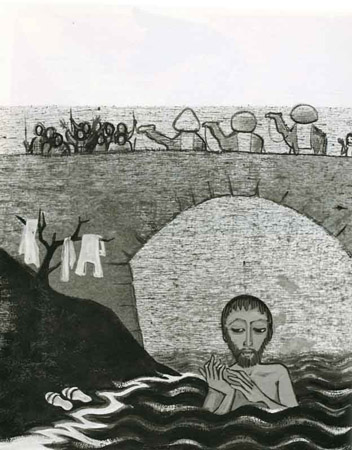
In this week’s story, we are introduced to Naaman, a general of Aram, who has a skin disease. He hears that there is a prophet in Israel who may be able to help him.
Questions to Consider
– Have you had a problem or diagnoses that you could not find a solution to? What resources did/do you you have to solve it?
– What are the barriers between Naaman and Elisha?
– What is Naaman (or the king of Aram) willing to give in order to get the healing that he needs? Is this instructive as we consider our pledges and offerings?
– In the end, what is Naaman actually asked to give up?