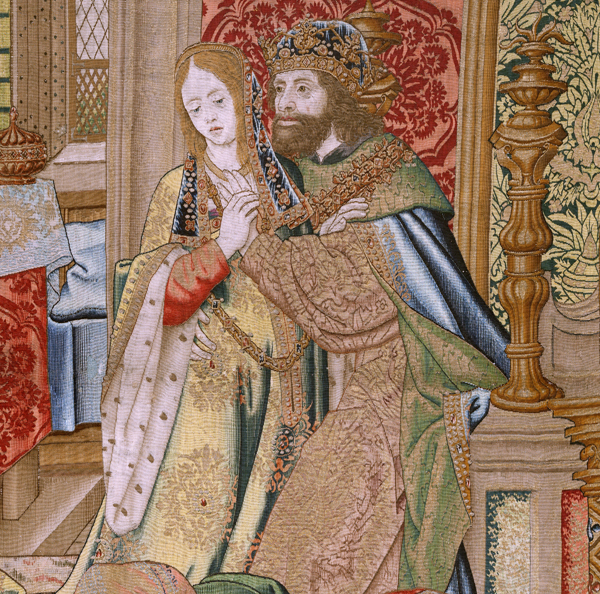
Kings Behaving Badly
by the Rev. AJ Ochart
CONTENT WARNING: This week’s scripture contains a depiction of sexual abuse and rape, and will be discussed as such as a part of the sermon. Please be aware of the ways that this content may effect you, and make use of appropriate strategies to mitigate or avoid harm.
2 Samuel 11:1-5, 26-27; 12:1-9
In last week’s scripture, the twelve tribes of Israel had taken control of the land of Canaan, and were encouraged by Joshua to serve the LORD. After the death of Joshua, the tribes formed a loose confederation to defend themselves and one another from the various other unaligned tribes. There were tribal leaders, of course; and cross-tribal leaders, called Judges, would rise in times of need. The scroll of Judges tells the story of this time using the following narrative pattern:
1. The people would stop following the ways of the LORD (usually by worshipping other gods)
2. God would allow one of the Canaanite tribes (e.g. Ammonites, Moabites, Philistines, etc) to threaten/oppress them.
3. God would then raise up a Judge to lead them to victory/back to righteousness
3′. The Judge reveals themselves to be flawed themselves (as the scroll goes on, they get worse)
4. The people worship God for a while, but after a while start worshiping other gods (return to 1).
According to the narrative, this goes on for around 300 years as the judges get worse and worse. The end of the scroll has an assessment that “In those days, everyone did what was good in their own site” (the narrative equivalent to dun dun duuuuun !). This sentiment is repeated at the beginning of the scrolls of Samuel, and are meant to connect the stories together.
The scrolls of Samuel are named after the last Judge who is born miraculously, raised in the Tabernacle, and effectively serves as a high priest (even though he is not of the priestly family or even a Levite) and prophet. When he gets old, and his sons show themselves to be untrustworthy to lead (a common refrain for this scroll, and the Deuteronomistic histories in general), the elders of the tribes come to Samuel and ask for him to anoint a king for them. He initially refuses, citing the repeated refrain that the LORD is supposed to be their king, but the LORD tells Samuel to go ahead.
The first king anointed is Saul, who is tall and stately, he looks like a king. He won an initial battle against Nahash the Ammonite, saving the residents of Jabesh-Gilead, which then gets all of the tribes behind him. Saul reigns a total of forty-two years according to the text, but in his later years becomes increasingly erratic. In a protracted battle with the Philistines, Saul remained frozen in Gilgal out of fear; in his impatience, he made a sacrifice instead of waiting for Samuel. Later, at Gibeah, he almost snatched defeat from the jaws of victory when he made a solemn oath that the army should not eat anything while they pursued the Philistines (which Johnathan had routed by himself). According to the text, the final straw was Saul’s attempts to enrich himself at the battle of Amalek; instead of razing the city to the ground, he preserved the livestock and king of Amalek. When Samuel arrived, he killed the king himself, and informed Saul that he was no longer the LORD’s anointed.
Samuel then anointed the next king, this time the youngest son of a man named Jesse. David was young and ruddy, but did not look like a king (yet). The text gives two stories about how David got into Saul’s orbit, but however it happened, David became one of Saul’s generals, and the darling of the people (including Saul’s own children). Saul tried to kill David multiple times, but with the help of Johnathan (Saul’s son) and Michal (Saul’s daughter), he was able to escape, and spent years evading Saul in the wilderness. David gained popular support and brought together a band of outcasts that would become his ‘Mighty Men.’ The text tells of a couple of times when David had the opportunity to kill Saul, but refused to kill one of the LORD’s anointed.
Saul and Johnathan were killed in a battle with the Philistines, and David was crowned the king of Judah (the northern tribes of Israel crowned Ishbosheth son of Saul). After a few more years of conflict, Abner (Ishbosheth’s general) defected to David, and David was crowned king of all of the twelve tribes (Ishbosheth and Abner were both killed by some of David’s Mighty Men; but he had no knowledge of it, in fact he read the reports at the same time you did and will certainly look into the matter more closely, no more questions at this time).
Now king of a united Israel, David overthrew the Jebusite city, which he renamed Jerusalem. He builds a palace, and has the Tabernacle and Ark of the Covenant brought there. Some twenty-or-so years into David’s reign, the Israelite army is in the midst of a two-year siege of the Ammonites. This spring David remains in his palace while his general, Joab, continues the siege. What David does next, will set the trajectory for the rest of his reign.
Questions to Consider
– How have you experienced the corruption of people (lets face it, men) in power?
– What does this text tell us about the place of women in this period?
– What does this text tell us about the consequences of our actions?