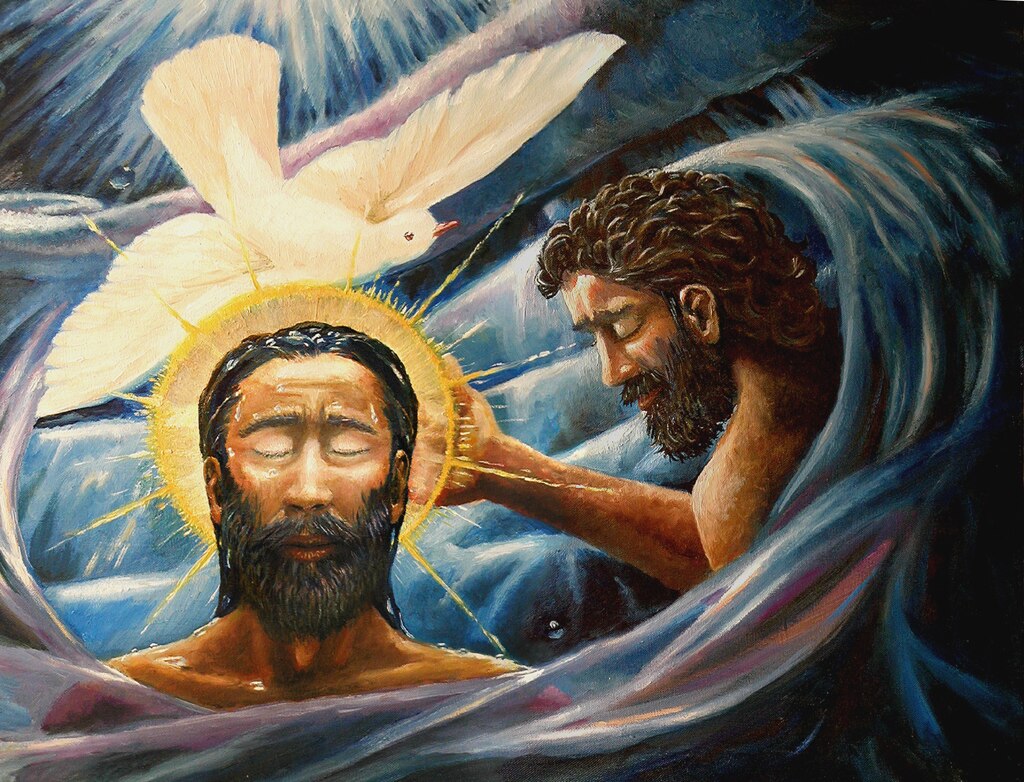
One Messiah, Two Messiah, Three Messiah… More?
by the Rev. AJ Ochart and Trey Austin
Zechariah 4:1-14, John 1:19-34
Sermon Notes
Merry Christmas! For this first Sunday of Christmas we turn to the Gospel of John, and John the Baptizer.
The introduction of John the Baptizer came in the theological introduction which AJ preached from at the 5pm Christmas Eve service. In this introduction, the gospel writer presents the divine Word (or Wisdom), Like, and Light that becomes enfleshed. In the poem, John the Baptizer is presented as one who testified to the Light, and the reason for his ministry.
First Century Palestine was a challenging time. In the time of Deutero-Isaiah, the Exiles were allowed to return to Jerusalem by the Persian Empire by Cyrus the Great (proclaimed as Messiah by Deutero-Isaiah). Later the Persian Empire was defeated by Alexander the Great and the Greek Empire, making Palestine a part of their territory. After the death of Alexander, Palestine was first under the control of the Ptolemies in Egypt, then the Seleucids. This was where the descendants of Judah became known as the Jewish people, using the Greek version of their people name. Under the Seleucids, the Jewish people gained brief national sovereignty under the leadership of the Maccabees (our Jewish siblings just celebrated the cleansing of the Temple at Chanukah, and also seen as Messiahs). Palestine was then conquered by the Roman Empire, and ruled by Herod the Great (which we hear about in the infancy narrative in the Gospel of Matthew.
After that Herod’s death, his four sons were made Tetrarchs of various territories. The southern territory, now called Judea, was ruled by Herod Archelaus for a little while. After several political and religious missteps, Rome banished Archelaus, and named Judea a Roman Provence, placing a Roman Governor in his place. The Northern territories, now called Galilee, were ruled by another one of the Herods, Antipas (outside of the references to Herod in the beginning of Matthew’s gospel, most scriptural references to Herod are to Herod Antipas).
This Greek and Roman influence caused various reactions from the Jewish population. These various communities also had different expectations for the coming of Messiah, or ‘anointed one,’ a future leader and Son of David. While Cyrus, Zerubbabel, Judah Maccabeus, an others were proclaimed to be Messiahs, many saw their work as incomplete, so waited for a truer fulfilment of the expectations of Messiah:
- Sadducees: The priests of the Temple in Jerusalem and rest of their tribe formed a religious/political party known as the Sadducees. These wealthy elites were more willing to collaborate with the Romans as a way to keep their religious freedom and preserve their own power. They favored a literal, non-supernatural, interpretation of Torah. The Sadducees expected a priestly king who would conquer the Romans, liberate his people, and restore Israel/Judah.
- Pharisees: The other political/religious party in the ruling body (called the Sanhedrin) were the Pharisees. These were also mostly wealthy elites, but were not of the priestly tribe. They were less willing to collaborate with the Roman cultural influence, and believed that more strict adherence to Torah would lead to freedom of their people. As such, they preserved the oral tradition of Rabbis (teachers) and their reflections on proper Torah observance. They were in the process of extending their reach outside of Jerusalem by establishing Synagogues. They had a more spiritual interpretation of the scriptures, emphasizing angels and the supernatural. They expected that Messiah to restore Israel/Judah to uprightness and Covenant Fidelity.
- Hellenistic Jews: Some of the Jewish people were much more open to the cultural and philosophical influences of the Hellenistic (Greek) world. They tended to interpret the Hebrew scriptures by focusing on deeper meaning, allegory, typology, and the and incorporation of Greek philosophical ideas. They saw he concept of Messiah as more of a archetype, rather than a literal person.
- Zealots and other violent resistors: Some chose to defy Roman oppression by taking up arms against it. Some groups focused on guerilla and terrorist actions, while others engaged in political assassinations of leaders they believed to be collaborators. These groups saw Messiah as a military leader, like the Maccabees, who would lead their people to victory and national sovereignty.
- Essenes: The Essenes were an ascetic/monastic group who saw the status quo as outright disobedience to God. They withdrew from the greater population and focused on ritual purity. Some biblical scholars suggest that John may have once been a part of the Essenes, especially noting that they share an emphasis on ritual cleaning. If so, however, John split off from the Essene community with his public baptism ministry.
- Little was known about the Essenes until the discovery of the Dead Sea Scrolls in the 1940s and 50s. From these preserved writings, we learned much about this isolated religious group. Fromm these writings we have learned that they expected the return of a prophet (associated with Moses and Elijah) and two Messiahs (Messiah Son of David, a conquering and ruling king, and Messiah Son of Joseph, the suffering and dying High Priest).
This week AJ will be on vacation, and Trey Austin will be filling the pulpit. Trey was previously ordained in another Reformed denomination and is now seeking ordination in the PC(USA) and has been accepted an an Inquirer by Foothills Presbytery.