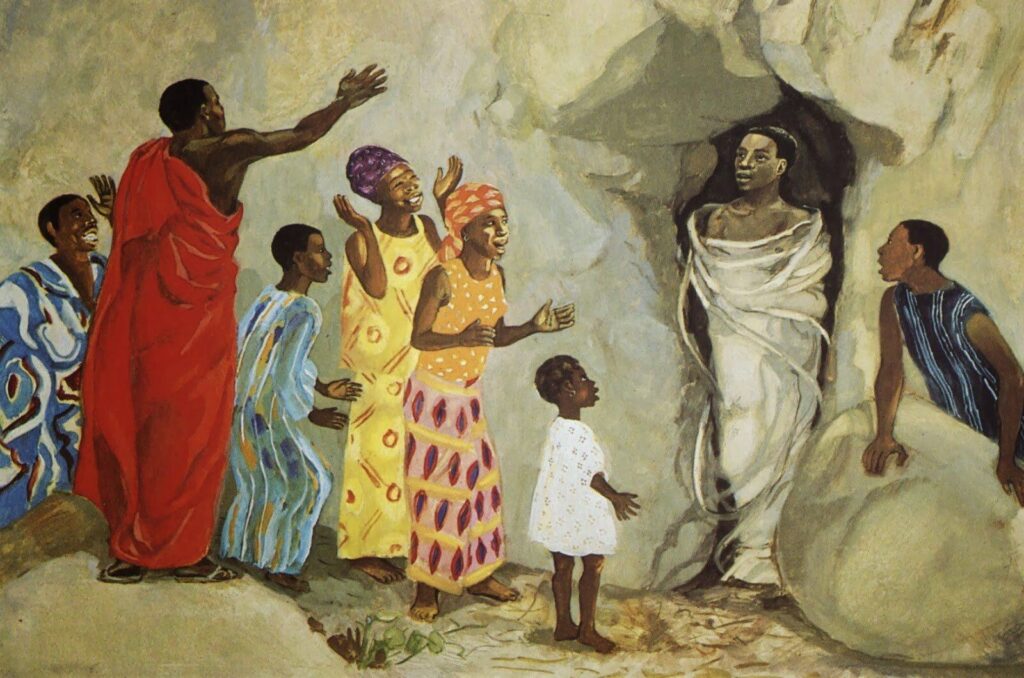
Bring Me To Life
by the Rev. AJ Ochart
- Serving Team at 9am
- Congregational Meeting after Worship
Sermon Notes
This week, we find Jesus on the other side of the Jordan River. The end of the “I am the good shepherd” sermon, which we heard part of on Ash Wednesday, ended with Jesus saying that “the Father and I am one.” This is a blasphemy too far for the Jewish authorities. Not only is Jesus claiming that God is his Father (don’t love it, but ok), but he also claims to be himself God! Their response is to try to kill him in a ritual stoning. Jesus and his disciples escape, and have retreated across the Jordan river. Here, however, they receive news that a man named Lazarus, from Bethany, and ‘the one Jesus loves’ is sick.
The characters of Lazarus, Mary, and Martha are fascinating ones. This story starts with Lazarus, so we will start with him. Lazarus is really only featured in this story. He is reported to be “he who you love,” which is in itself interesting (especially for a character who we have not been introduced to before now). In Luke 16, Jesus tells a parable about a rich man, and a poor man named Lazarus, the only parable which gives a specific name for the person. Some suggest that the Lazaruses are the same, though the parabolic Lazarus is clearly poor, and this Lazarus seems to be more well off (e.g. important Jewish authorities come to grieve him, and he has his own tomb). Another interesting connection may be with some later references to “the disciple that Jesus loved” who we see reclining on Jesus at the Last Supper, and outruns Peter to the tomb. Some have suggested that this beloved disciple is Lazarus, since he is introduced as the one that Jesus loves. Of course, this could also be a coincidence or unintentional connection. Lazarus will later be directly referred to, but simply as the one that Jesus raises in this story.
Perhaps more interesting are Mary and Martha. This is the first time the two are introduced in this gospel, though they make appetences in Luke as well. Mary is introduced as “the one who anointed the Lord with perfume and wiped his feet with her hair,” which has not happened yet. This anointing is one of the few events that appears in all four gospels, though the one doing the anointing is referred to as Mary, Mary Magdalene, and simply ‘the woman from Bethany’. The significance of this anointing cannot be understated, and is suggested in the foreshadowing we see here.
Biblical scholars suggest that Mary Magdalene (or Mary ‘the Tower’) was one of the foremost leaders in the early church, along with Simon ‘the Rock’ Peter, and Paul (who didn’t get a nickname). The very early church seems to have been an egalitarian movement, where women and men served in various roles. A quick read over Romans 16 reveals several women in leadership positions, and given the title of Apostle. In fact, one of the assessments of the Christians by the Romans was that it was a ‘religion of women and slaves.’ As you may be (painfully) aware, however, it did not take long for Patriarchal thinking to waltz back in, demanding to be the center of attention. The theory goes that as early as the first few decades after Jesus’ death and resurrection, that these various leaders vied for authority. The final victor in the first century was Peter, who became the precursor to the Pope. Paul and his ministry were placed in subjection to Peter, there are many early depictions of Paul submitting himself to Peter when he returns to Jerusalem. Paul would later come to the fore in the Protestant Reformation.
In this reconstruction, Mary the Tower was not only a rival leader to Peter, but a woman. There are indications that in the original version of the gospel that we call John, Mary played a more prominent role, but that this role has been edited out. First of all, there is the introduction of her as being the one who anointed Jesus (and remember that Messiah and Christ both mean ‘anointed’). This story also features and interesting textual duplication, when both Mary and Martha meet Jesus, they say exactly the same thing. Some suggest that this duplication is a sign that the text may have been modified, and there was originally only one sister asking the question. The theory goes that the Pro-Peter Patriarchal Party* of the church did not want to continue the tradition of women in leadership positions, so they began erasing or obfuscating women’s leadership roles, and especially Mary Magdalene. In this story, they added another sister, Martha, to confuse Mary Magdalene with the Mary/Martha duo from Luke. This also removes the profound declaration of Jesus’ divinity “Yes, Lord, I believe that you are the Messiah, the Son of God, the one coming into the world” from Mary, and gives it to Martha. This crew was also responsible for the pseudo-Pauline epistles, in which Paul goes from praising women to making sure that women follow strict household codes. These actions resulted in a decidedly Patriarchal direction for the early church, which fit more in line with Roman sensibilities and positioned Christianity to eventually be the official imperial religion. And with men in charge of the church, there were never any problems…
Anyways, Mary (and Martha) are important to this story, and the Christian tradition. Another major theme in this story is that of Resurrection, but I will address that more in my sermon.
*no one calls them that, I just like the alliteration
Questions to Ponder
– When have you experienced God/Jesus not responding in the way or timing that you would like?
– How have you experienced Resurrection in your own life?
– How might you be called to ‘come out’ of your grave?