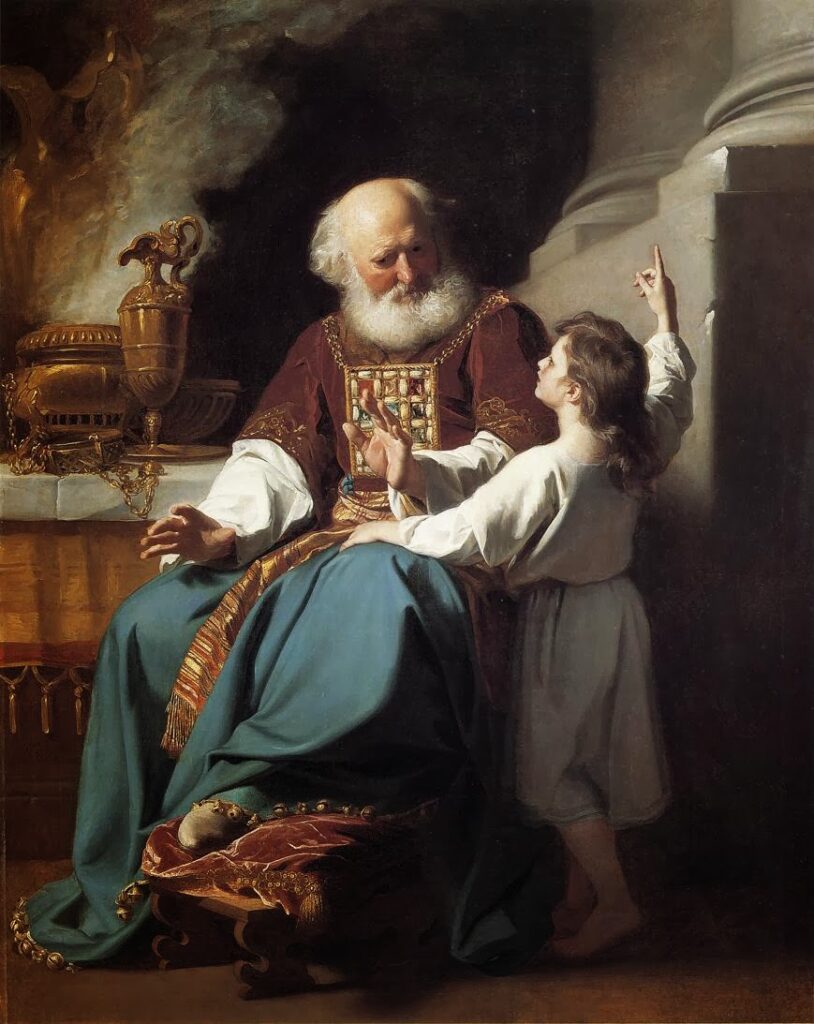
Speak LORD, For Your Servant is Listening
by the Rev. AJ Ochart
Sermon Notes
This week, we have skipped over several books, leaping from Torah to Nevi’im (Prophets). Here is a quick overview of the story we are skipping over:
The Hebrew people got to Mt. Saini where they receive the Torah Instruction from the LORD through Moses, and where God makes a Covenant with them. They build a movable Temple called the Tabernacle (‘Tent of Meeting’), and receive the instructions for the Priests (Leviticus). When they reach Canaan, they are afraid to go in, so they wander in the wilderness for forty years (‘Numbers’, or the much more helpful Hebrew Title ‘Wilderness’). After the forty years are up, they return once again to the Jordan River, the boundary to Canaan, and Moses retells the Torah to them (‘Deuteronomy’ or ‘second telling’). This concludes the first section of the Hebrew Scriptures, Torah.
The second section, Nevi’im or Prophets, begins with Joshua leading the Hebrews into Canaan, conquest of the land, division of the land to the twelve tribes, and a renewing of the Covenant. During the time of the Judges, the people go through a cycle of unrighteousness, external threat, God raising a warrior/leader/judge, the people going back to worshipping God, until they don’t, and the cycle starts all over again. By the end of Judges, we are told that “everyone did what was right in their own eyes.” (The Book of Ruth is set during this time, but is considered a part of the Ketuvim (writings)).
The epic of Samuel starts in the time of Judges and tells about the rise of the first kings of Israel and/or Judah. We hear of a man named Elkanah and his wives Hannah and Peninnah. They have gathered at Shiloh, where the Tabernacle has been placed, for a thanksgiving feast. Hannah is distraught because she has not be able to bear children (a fact which is exacerbated by Peninnah mocking her about it), so she goes to the Tabernacle to ask God for a son. She prays fervently, and makes an oath that if the LORD would give her a son, she would give him back to God as a servant. The High Priest, Eli, sees her in the Tabernacle, and at first thinks that she is drunk. When she tells him that she is praying, he tells her that the LORD will grant her prayers. Months later she finds out that she is going to have a child, and sings a beautiful song about the God who listens to the cries of the oppressed, lifts them up, and tears down the haughty from their places. When the child, Samuel, is weaned (3 or 4 years old), she brings him to Shiloh and gives him to Eli to serve God (toddlers, amiright?).
Meanwhile, Eli’s sons, Hophni and Phinehas (or Phinehas and not-Ferb, if you prefer), are also serving as priests of the LORD. However, they are scoundrels, and misuse their power and authority. Eli was aware that they were stealing people’s sacrifices and sexually abusing the women, but did little than lecture them. One day, a man of God (one of the names for prophets) came to Eli and promised death and destruction because of the unrighteousness of Eli’s sons.
Through it all, Samuel “continued to grow both in stature and in favor with the LORD and with the people.”
Questions to Consider
- Have you ever heard God?
- Have you ever had to help someone discern God’s voice?
- Have you ever had to deliver a difficult message?