Troubling Instructions
by the Rev. AJ Ochart
Remember to wear your team colors or apparel this Sunday, and join us for a Wednesday Night Tailgate.
Scripture
Sermon Notes
Last week in the Narrative Lectionary, we heard the creation narrative from Genesis 1. The land and the skies are created by God, and humanity is created in God’s image. In Genesis 2 we hear another creation story, this time humanity is created to care for the garden that the LORD plants, and charged to nurture and care for it. However, humanity chooses to define good and evil for themselves, and are expelled from the garden. The rest of the Pre-History section of Genesis (Ch. 1-11) tells the story of humanity being so filled with violence and chaos, that God chooses to de-create them in the flood. One righteous man, Noah, and his family are spared and God makes covenant with them. Humanity is then spread all over the world.
The Abraham Cycle (collection of connected stories) starts in chapter 12 of Genesis, when the LORD chooses Abram and instructs him to leave his homeland of Haran, and go to Canaan. The LORD promises that Abram will be made into a great nation, and that all of the Nations of the earth will be blessed through him. The LORD also promises the land of Canaan to Abram’s descendants. Abram takes his barren wife, Sarai, and his nephew, Lot. They have several (mis)adventures.
Years later (Genesis 15), the LORD returns to Abram promising to be Abram’s shield. Abram, however, is concerned that he has no children yet, and is not getting any younger. The LORD calls Abram outside and count the stars claiming “so shall your descendants be.” Abram believed the LORD, and the LORD “reckoned it to him as righteousness.” The LORD made a covenant with Abram there.
Abram and Sarai take matters into their own hands, misusing Hagar (an enslaved Egyptian women) in order to bear Abram’s first born son, Ishmael. When Hagar tries to flee Sarai’s abuse, the LORD finds her and Ishmael in the wilderness. Hagar names the LORD El-roi, ‘the God who sees’ and she returns to Abram and Sarai.
In Genesis 17, God makes a (another) covenant with Abram, this time instituting male circumcision as the ‘sign of the covenant.’ God renames Abram and Sarai, as Abraham and Sarah. Names are often important in the Hebrew Scriptures, Abram means “exulted father” or “high father,” and Abraham means “father of a multitude.” Sarai means “my princess” or “my lady,” Sarah means the same, but takes on a further connotation of being a more universal princess or lady (‘Sarah’ is the feminine form of the Hebrew word meaning chief or ruler). God again promises many descendants for Abraham, specifically through Sarah. Abraham laughs at the idea, since he is ninety-nine and she is ninety (and also God has just asked him to be wounded in his baby maker).
In Genesis 18, the LORD appears to Abraham as three travelers. Abraham shows them hospitality by preparing a feast, and they promise that within a year Sarah have a son. Sarah, listening at the tent laughs at the prospect.
The LORD also wishes Abraham, who is the ancestor of kings, to understand the coming destruction of Sodom and Gamora because of the great outcry that has risen because of their injustice. Abraham negotiates with The LORD to show mercy if ten righteous people are found in the cities (spoiler: there are not even ten). The angels sent to investigate are shown (some) hospitality by Abraham’s nephew, Lot; but the men of the city show their injustice and lack of hospitality by trying to dominate them*. This seals Sodom’s fate, and Lot and his family escape (mostly).
This week, we hear of the birth of Sarah’s son, Isaac (whose name means laughter).
In the rest of Chapter 21 (which we will skip over), Abraham (once again) sends Hagar away with Ishmael. God promises Abraham that Ishmael will also become a great nation. “Abraham rose early in the morning” to send Hagar and Ishmael away with a few provisions. When the supplies are gone, God hears the voice of the dying child in the wilderness, and saves him and his mother, revealing a water well. God promises Hagar that Ishmael will be a great nation. When our Muslim siblings tell this story in the Koran, they tell of Abraham and Ishmael traveling to Mecca and building the first Kaaba (black cube in the center of Masjid al-Haram).
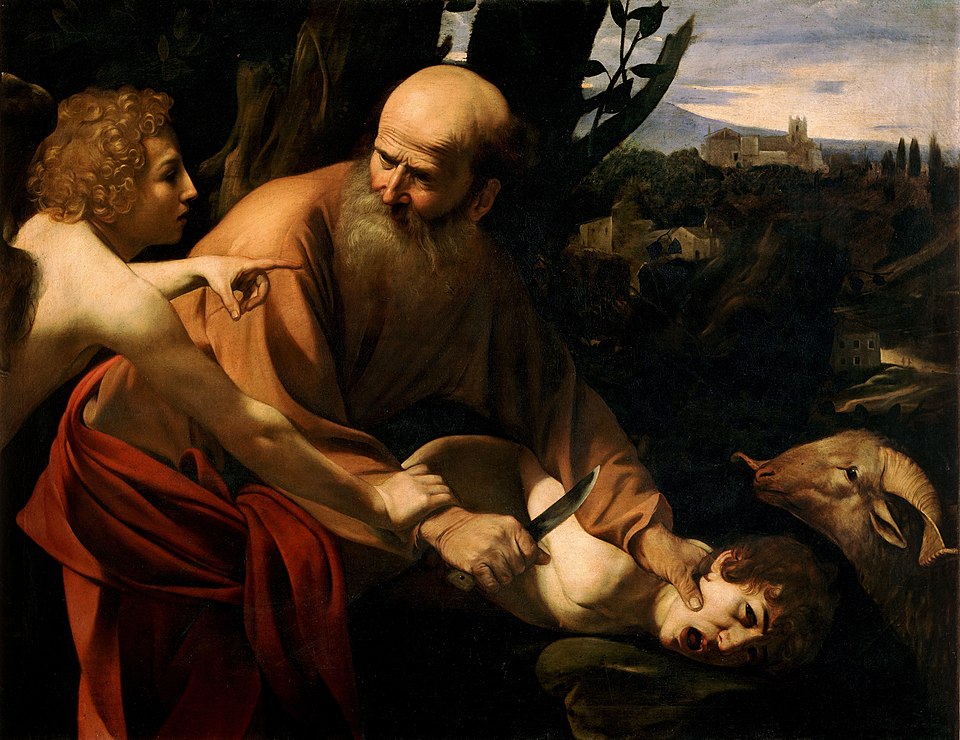
In Chapter 22, God asks that Abraham also sacrifice his other son Isaac, this time on an altar.
*This attempt at forced domination is considered by many modern Christians to be a polemic against homosexual activity; however the prophet Ezekiel indicates that the more original understanding was that Sodom and Gamora were guilty of greed and neglect of the poor. Jesus uses the cities as examples of a lack of hospitality.