Blessings and Curses
by the Rev. AJ Ochart
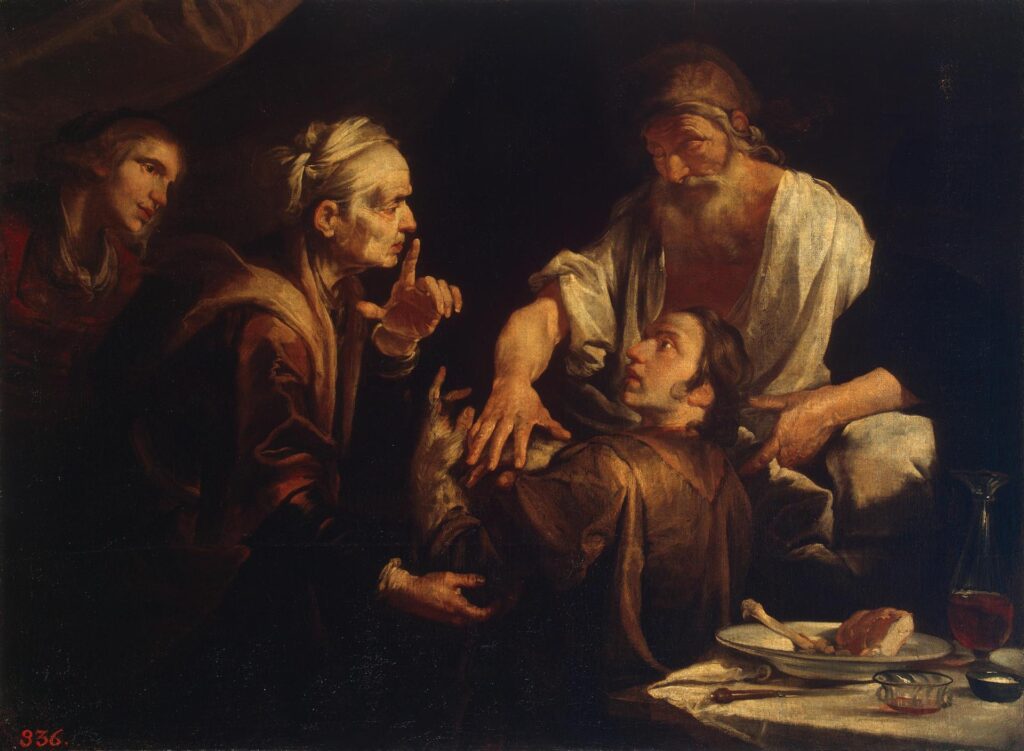
Genesis 27:1-4, 15-23; 28:10-17
Sermon Notes
Last week in the Narrative Lectionary, we heard about the miraculous birth of Isaac, the son of Abraham and Sarah. We also heard about the instruction to sacrifice Isaac as a test, which God stopped at the last moment. Interestingly enough, there are no stories in which Abraham and Isaac interact after that story (can you blame them?)
Sarah died, and Abraham bought a piece of land from the Hittites on which she could be buried; near Mamre, where he had first talked to the LORD in Canaan. Finally, after decades of wandering around as a nomad, he had a piece of land of his own. Abraham sent his enslaved man to Haran, where Abraham’s extended family still lived, to find a wife for Isaac. Abraham did not want Isaac marrying one of the Canaanite women, but to have a nice cousin-wife (this will remain a theme throughout Genesis). Abraham also did not want Isaac to go to Haran, likely because it might endanger the tenuous hold they had on the land. The enslaved man traveled to Haran and, with the help of the LORD, met Rebekah (Isaac’s second-cousin; daughter of Abraham’s brother’s son). He negotiated with her brother, Laban, for her hand in marriage to Isaac. While Laban attempted to get everything he could out of the deal, Rebekah was willing, and traveled with the Abraham’s enslaved man back to Canaan.
Isaac and Rebekah fell in love immediately and were soon married. Throughout the book of Genesis, Isaac and Rebekah’s relationship is the least talked about, but also seems the healthiest (a chicken and egg sort of riddle), however; Rebeka was unable to bear children. Isaac prayed to the LORD, and God opened her womb and she conceived. It was s difficult pregnancy, and after she inquired of the LORD, she received this oracle:
“Two nations are in your womb,
and two peoples born of you shall be divided;
the one shall be stronger than the other;
the elder shall serve the younger.”
When her time came, it was discovered that she had twins, both assigned male at birth. The first one to be born was red and harry, so they named him Esau (meaning ‘harry’). The second child was born holding onto Esau’s heel (as if trying to hold him back, or get ahead of him). They named this child Jacob (meaning ‘he grasps the heel’ which was, or became, an idiom for deception). While the two were born only minutes apart, Esau was still considered the firstborn, with all of the cultural privileges and assumptions that came with it. The firstborn son was given a birthright, the honor of continuing the birthright line, as well as being considered the head of the tribe when their father died. The firstborn also received at least half of the father’s estate (the rest being divided among any other sons).
As the twins grew, they could have not been more different. Esau was “a skillful hunter, a man of the field.” He was highly masculine presenting, a ‘jock’ or an ‘Alpha’ depending on your cultural location. He was a skilled hunter, preferring the outdoors. He was also the favorite of his father, Isaac, (another theme that persists throughout Genesis). Esau was also not the brightest crayon in the box, preferring to put his points into Strength and Constitution, rather than Intelligence or Wisdom.
Jacob, on the other hand, was “a quiet man, living in tents.” He was more effeminate presenting, and might be considered a ‘nerd,’ ‘theater kid,’ or ‘mama’s boy’ or a ‘sigma’ (again depending on your generation). He preferred to stay near the tents, and was the favorite of his mother, Rebekah. Jacob was also cunning and crafty. He may not have been the strongest brother, but he was happy to use other strengths.
We see this contrast in a story where Jacob is making a stew when Esau bursts into the tent from hunting. Esau is starving, and asks Jacob for some of that ‘red stew.’ Jacob agrees to give him the stew in return for Esau’s birthright. Esau (who claims that he is dying, and as I said, not that bright), accepts the offer. This is where he gets his other name, Edom (meaning ‘red’), a name shared by a sometimes-enemy nation of ancient Israel and Judah.
This odd paring of twins/siblings is a motif that we see across cultures, often signifying opposites like the sun and moon. Likely the most famous one (and one that parallels Esau and Jacob most closely) is that of Thor and Loki from Norse mythology and/or Marvel Comics. Other pairs include Apollo and Artemis, Quetzalcoatl and Xolotl, Nut and Geb, and of course Vincent and Julius.
As we come to our first reading, Esau has married not one, but two Hittite women (which “made life bitter for Isaac and Rebekah”). Isaac has gotten old and blind, and seems to believe that he will be dying soon (spoiler, he will not die for another 8 chapters). Isaac wishes to give his blessing to Esau his oldest (also favorite, also dumbest) son. It seems this is meant to the the blessing of the LORD that was given to Abraham, passed (we assume) to Isaac, and now he wishes to extend to Esau. This blessing would normally be a joyous occasion with a large feast for the whole family, but Isaac instructs Esau to go and hunt some game for their own private feast. Rebekah hears of these plans, and starts some plans of her own.
Questions to Consider
- How are the humans in the story thinking about birthright and inheritance?
- How has God’s view of inheritance and birthright already been different in the story?
- How will the oracle from Rebekah’s pregnancy play into the ongoing story?
- How do we/you restrict God’s blessings in ways that God does not intend?