The God Who Is
by the Rev. AJ Ochart
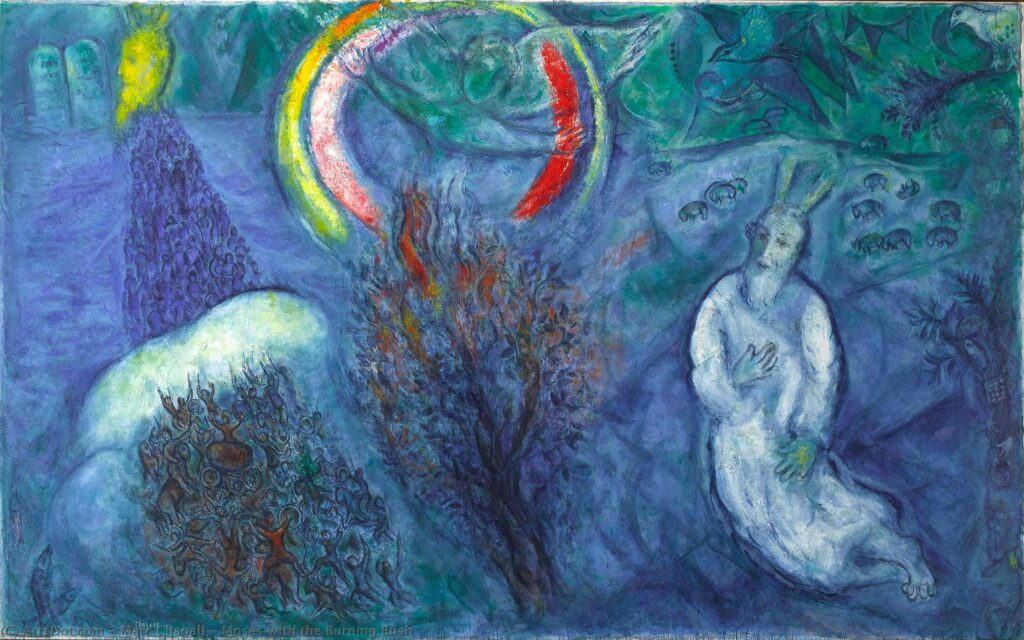
Exodus 2:23-25; 3:1-15; 4:10-17
Sermon Notes
This week we move from the scroll of Genesis to the scroll of Exodus. When we last left our heroes, Jacob was leaving the land of Canaan to find a cousin-wife from Haran. While in Haran, he contracts with his cousin Laban for seven years of labor in return for marrying his daughter, Rachel. However, when his seven years were up, he found Leah (Racheal’s older sister) in his marriage bed. Jacob contracted for another seven years in return for Racheal. Leah and Racheal compete over bearing children, with the use of their enslaved women Bilhah and Zilpha. By the time Jacob returns to Canaan he has four wives, twelve children, and gets a new name Israel (God contends).
Racheal, Jacob’s favorite wife, dies in childbirth with her second son, Benjamin. Racheal’s firstborn son, Joseph, is Jacob’s favorite, which his brothers hate him for. Jacob gives Joseph a special piece of clothing* and his brothers sell him to Midian enslavers, telling their father that he was killed by wild animals. Joseph is blessed by God in Egypt, and becomes the embodiment of the ‘Image of God’ as under his management Egypt is saved from a severe famine. Joseph invites his family to live in Egypt, and forgives his brothers for their actions against him. The scroll of Genesis ends with Israel and his children in the land of Egypt.
Even though you intended to do harm to me, God intended God intended it for good” Genesis 50:20 NRSV
The scroll of Exodus is set four hundred years later. A new Pharaoh has risen to power who does not know about Joseph, and sees a large number of not-Egyptians in his land. He is worried that they pose a security threat to his nation, and that they keep breeding, so he enslaves them to build his cities. However, God continues to bless the Israelites. Next the Pharaoh enlists the help of two midwives, Shiphrah and Puah, to kill any of the Hebrew babies who are born male. However, the midwives feared God, and conscientiously objected, keeping the babies alive. Finally, the Pharoah abandons all pretense, and orders that any male Hebrew baby must be thrown in the Nile.
Around this time, a couple from the tribe of Levi have a baby boy. They choose to defy the edict, and hide him for three months. Finally, his mother throws him into the Nile, but inside of a floating basket. The basket is found by the daughter of Pharoah herself, who choses to save him. She knows that he must be one of the Hebrew children (who else would be so desperate as to float their baby down the Nile), and saves this one child. She hires the baby’s mother to care for him until he is weaned, and then adopts him. Pharoah’s daughter names him Moses (which in Egyptian sounds like ‘son’ and in Hebrew sounds like ‘draw out’).
We have no account of what life was like for Moses growing up in the Egyptian palace, but later in life he is walking among the Hebrews and kills an Egyptian guard who is beating a fellow Hebrew. Moses flees the land of Egypt and settles among the Midianites (a cousin people, descendants of Abraham and his second wife, Keturah). As our story begins, Moses has married the daughter of the local priest, and is watching over his father-in-law’s sheep. However, God has heard the cries of the Hebrews in Egypt, and will send this unlikely savior to “let my people go.”
*the Hebrew is unclear, but it has been translated as a ‘coat with long sleaves’ a ‘coat of many colors’ or something like that. The only other time the specific phrase is used is to describe the clothing that David’s daughters wore, so ‘pretty princess dress’ is also within the realm of possibility for translation
Questions to Consider
- What does this story tell us about God’s character?
- What does this divine name of God, “I AM” mean?
- What excuses does Moses give for not wanting to be sent to Egypt?
- What excuses do we give for not wanting to follow God’s call?