So That You May Continue To Believe
by the Rev. AJ Ochart
Sermon Notes
Jesus has risen (he has risen indeed). Last week we heard about Mary Magdalene coming to the tomb where Jesus’ body had been laid, and finding the stone had been rolled away. She told Peter and the Disciple Jesus Loved about it, who rushed to the tomb to discover that it was not only empty, but that the burial cloths had been neatly folded or rolled. After the men went back home, Mary Magdalene was then asked what she was looking for by two messengers, and then a mysterious figure (who she thought was the gardener, but we are told is Jesus). Jesus says Mary’s name, and she recognizes him, but he tells her not to hold onto him and to tell the other disciples that she has seen the Lord.
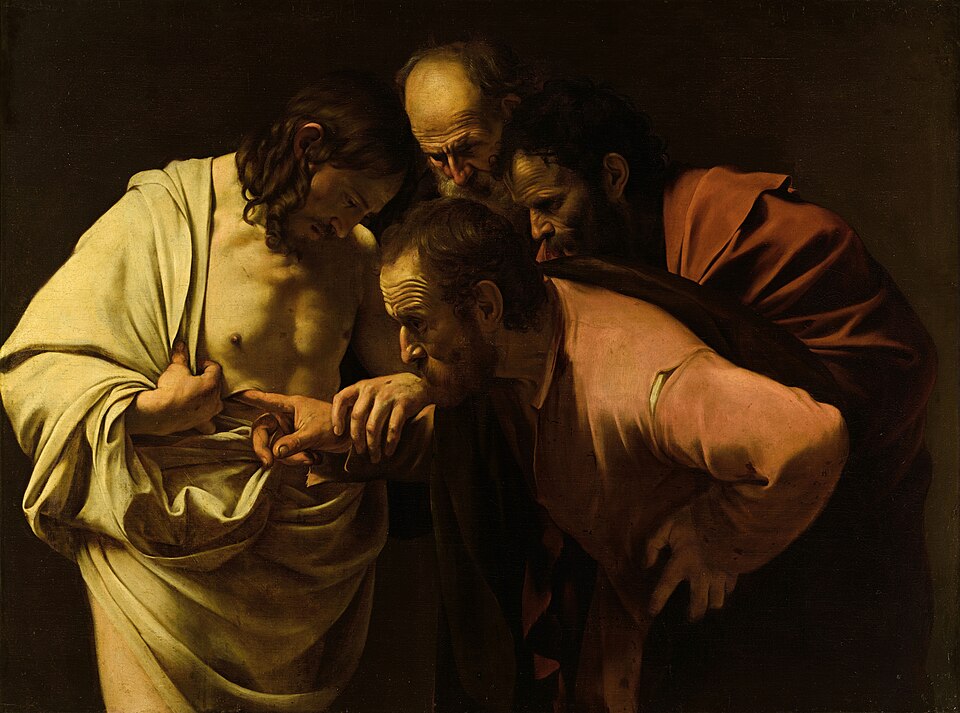
This week we join up with the disciples later that day and encounter Jesus themselves. Thomas, however, missed out on seeing Jesus, and refuses to believe until he has further evidence. We will also read about the following week (also a Sunday), when he gets his wish.
The focus of this text is on Thomas’ reaction, he is often called ‘doubting Thomas’ (though I wonder if something like ‘verifying Thomas’ is better). This text has often been used in high-control religious communities to vilify doubts or questions. To be sure, Jesus’ final words in this section are, “Have you believed because you have seen me? Blessed are those who have not seen and yet have come to believe.” However, I believe that questions and doubts are an important part of the process of spiritual growth and formation. Perhaps the story of Thomas is an invitation to dive deeper ourselves, to investigate, to question, to grow.
Author Brian McClaren suggests that we go through 4 stages in our faith formation: 1. Simplicity, where we simply receive our beliefs (understanding, dogma, ideology, worldview, etc.) from our parents, church leaders, environment, etc. Sometimes (often), however, we encounter evidence (data, other perspectives, other experiences, etc.) that does not fit into that simple view of the world, so we enter the next stage, 2. Complexity. At this point, this countervailing information is still seen as an exception, an outlier, a blip. However, sometimes this cognitive dissonance piles up so much, that we move to the next stage: 3. Perplexity. In this stage, this evidence that goes against our original beliefs can no longer be ignored, and must be addressed. This can be an exceedingly difficult and unmooring stage, especially if the belief being perplexified (not a word) is one that is seen to be foundational. Some people choose to abandon the process or hold even more firmly to the original belief. If not abandoned, the cycle concludes with the last stage, 4. Harmony. In this stage, the cognitive dissonance is resolved by updating the belief to include the new evidence. This is an ongoing cycle of spiritual maturation, sometimes going through belief’s one at a time, or many beliefs being reevaluated in a wave. McClaren’s focus is religious beliefs, but this cycle also works for political, racial, gendered, personal, or other beliefs about the world and how it works.
Examples abound in our scriptures and our personal lives of this process, including (but not limited to) our text today.
Questions to Ponder
– How do you think the disciples were feeling at the beginning of the text? How did that change?
– What questions or doubts have you had, what has been the result of those questions or doubts? What beliefs have you changed over the years, what has remained the same?
– What fears or pressures have caused you to shut down these questions, doubts, or processes?