Basic Instructions Before Leaving Earth
by the Rev. AJ Ochart
Exodus 19:3-7, 20:1-17
Last week the Narrative Lectionary skipped over hundreds of years of history, this week only a month. The People of Israel have been freed from enslavement in Egypt, and crossed through the sea. But they find that life outside of Egypt is a lot more difficult than inside it (even in slavery). As they wander through the wilderness of Sin (pronounced Syn, like Mt. Sinai) they encounter several troubling encounters:
- They find water (an essential in the desert wilderness), but the water is tainted. They complain to Moses, Moses cries out to the LORD, The LORD gives a clearly miraculous solution (throw a stick in the water), problem solved.
- They run out of food (except for all of the livestock that they have brought with them). They complain to Moses, Moses cries out to the LORD, The LORD gives a clearly miraculous solution (a flock of quail, and magic bread to gather each morning), problem solved.
- They run out of water again. They complain to Moses, Moses cries out to the LORD, The LORD gives a clearly miraculous solution (hit a rock with a stick, and it starts pouring out water), problem solved.
- As a fun aside, the Mishna (a set of Rabbinic expansions on Torah), this rock then continues to follow them, rolling along behind them. In fact, it seems that the Apostle Paul makes reference to this “the spiritual rock that followed them” in 1 Corinthians 10:1-4.
- They are attacked by the Amalekites. They complain to Moses, Moses cries out to the LORD, The LORD gives a clearly miraculous solution (military victory as long as Moses has his hands held up), problem solved.
- The pattern is broken when Jethro, Moses’ father in Law, brings his wife and sons to him, then gives sage advice and worships the God of Moses (which he seems to have worshiped before, but whatever).
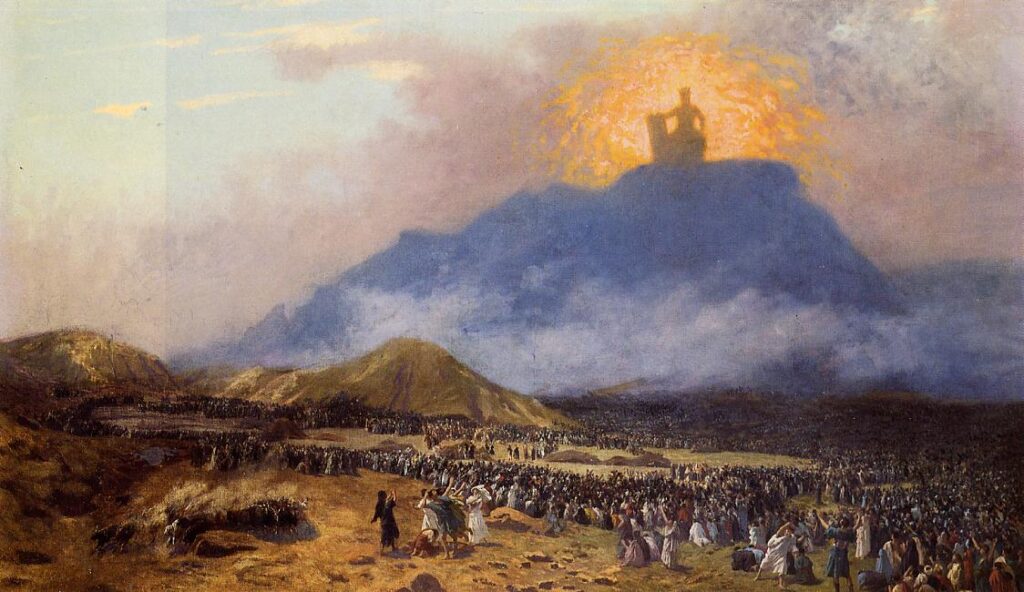
Now the people have come to Mt. Sinai, the mountain where the LORD spoke to Moses in the burning bush. One of the questions that Moses had asked of the LORD was proof that God would be with him in this mission to free his people, and the proof was this very return, “I will be with you, and this shall be a sign for you that it is I who sent you: when you have brought this people out of Egypt, you shall worship God on this mountain.” (Exodus 3:15).
The LORD calls on Moses to consecrate (set aside for holy use) the people, and prepare them to hear the instruction (torah) of the LORD. After three days of consecration, the LORD descends in a cloud of fire and lightning into the mountain, and speaks the beginning of this Torah, what we in Christian circles call the ‘Ten Commandments”.
These instructions are a simple version of the rest of the instruction that will come, an invitation into a just and righteous society in which humanity may flourish. It is also the beginning of the covenant made between the LORD and this people (according to Jewish theology, this covenant is not only with those who have gathered, but all their descendants as well). Our text refers to this people as a “priestly kingdom and a holy nation,” this is the reason that our Jewish siblings are sometimes referred to as the ‘Chosen People’. It is a continuation of the call that God made to Abram, and the promise that all the families of the world would be blessed through him. This image and idea was later developed in Christian theology that through the life, death, and resurrection of Jesus we have been received into this Family of God; which our Reformed tradition calls ‘Election’ and the ‘priesthood of all believers’.
These ten words also have a long history of interpretation and use, from Jesus being asked what the greatest commandment is, to recent legislation in the United States posting the Ten Commandments (at least a version of it) in schools.
Questions to Consider
– What is your experience with the Ten Commandments?
– What commandments do you have a hard time with, which ones are easier, which are confusing?
– What is the role of choosiness or election, and what does it mean for the way that we interact with others?