A Future with Hope?
by the Rev. AJ Ochart
Sermon Notes
This week we skip yet another two hundred years, and a lot has happened. The destruction that the prophet Amos warned the kingdom of Israel has came to pass. The land was invaded by the Assyrian Empire in 732, the capital Samaria destroyed, and the people spread all over the empire. Only a small remnant remain in the land, mostly the poor and disenfranchised that Amos had talked about.
The kingdom of Judah, to the south, was also invaded by the Assyrians. They laid siege to Jerusalem; however, the Assyrians retreated suddenly and Judah was safe. Prophets, like Isaiah, argued that they were turned away by the hand of the LORD, but that God still wanted righteousness from the leaders and people of Judah, or they would suffer the same fate as Israel. This time saw a few actually righteous kings, Hezekiah and Josiah, who oversaw reform movements, reinstituting the worship of YHWH at the Temple (instead of Ba’al and other gods), and had the people renew the Covenant once again*. However, for every step forward, the next king took two steps back, and the nation would soon fall back into unrighteousness.
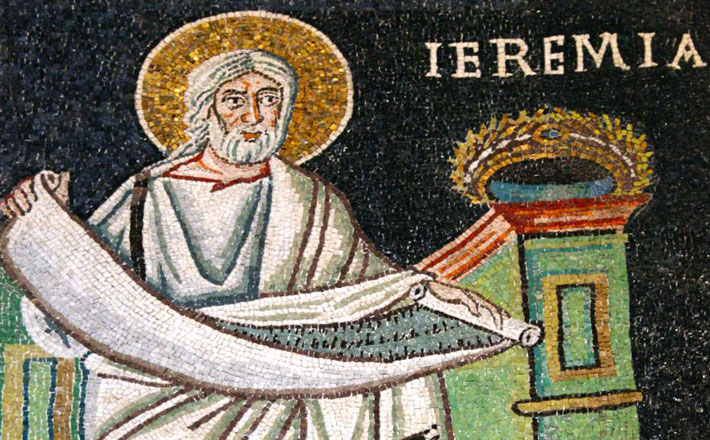
The Prophet Jeremiah began his ministry in this time between exiles. He was called as a prophet to Judah and the nations, preaching coming destruction but also hope. He, like Elijah, was concerned with the nation’s unfaithfulness to the worship of other gods, making a comparison between this worship and prostitution. He, like Amos, was also concerned with the lack of justice and righteousness, specifically focusing on the poor and downcast. After twenty years of speeches and sermons in the Temple and the cities of Judah, God inspired him to write them down with the help of a scribe, Baruch. The scroll of Jeremiah is an anthology of those speeches and sermons, as well as narratives about Jeremiah, his prophetic signs, and interactions with the Jerusalem Elites. Before the Exile, Jeremiah’s words are harsh and strong, pleading with people to repent (change direction, change their hearts). However, after the destruction, Jeremiah’s tone shifts somewhat, turning up the level on the hope in the midst of great challenges.
In 605 BCE, Nebuchadnezzar II of Babylon laid siege to Jerusalem in a conquest for more lands. King Jehoiakim of Judah agreed to pay tribute to Babylon, becoming a vassal state of the Empire. In 601 BCE, Jehoiakim stopped paying that tribute, resulting in the siege of Jerusalem, and its defeat in 597 BCE. Jehoiakim was killed in the siege, and his successor Jeconiah and several of the Jerusalem elites were brought to Babylon. Some of the prophets that remained assumed that their exiled kin were being punished by God. Some of the prophets who were exiled told the people that they would soon be returned. Jeremiah, who remained in Jerusalem, claimed that those taken to Babylon were actually God’s chosen ones, but that they would need to remain for generations. Throughout the rest of his ministry, Jeremiah assured that God remained faithful to God’s people, and that the exiles would one day be allowed to return.
On Christ the King Sunday, the last Sunday of the Liturgical calendar, we are reminded that Christ alone is the final authority for our lives. While we may suffer terrible consequences sometimes, whether of other people’s actions or our own; God is always faithful, and calls us forward to a future and a hope. However, this letter also reminds us that while the moral arc of the universe bends towards justice, sometimes it takes a long time. We may not see the results of the actions that we put into place, and our progress may be wiped out by someone else’s regressive reforms, but God remains faithful and works all things together for good… eventually. Our call today (as in every day) is to do the best with what has been given to us, to work to exhibit the Kin-dom of God to the world, to live into the truth that the Lord of Lords and the King of Kings is the slaughtered lamb upon the throne.
*Text-Critical analysis if the Hebrew scriptures suggest that the earliest written form of the Torah was developed during the time of Josiah, blending several oral traditions from both Israel and Judah.
Questions to Consider
- What catastrophes have you experienced, personal, national, global?
- How have you glimpsed God’s future and hope in your life?
- How can you better live into your allegiance to Christ the King?